Blog Entry 31:
When pondering Tim's advice, I decided to start by looking at what in other's work depicts the divine (/impossible/ etc.) To find out what I perceive to depict said divinity, I have looked back at religious artwork I have already studied with a view to understanding what visually creates the feeling of the divine or religious connotation. Tim advised me to do this without focussing too much on the obvious aspects that may portray divinity, and to focus more on aspects such as character or subject's reactions or poses and objects of interest.
Leonardo da Vinci:
The Last Supper:
The Last Supper and Hand Gestures:
 |
| The Last Supper Leonardo da Vinci, (1494 - 1498) eggyolk, vinegar and oil on dry palster, Maria delle Grazie, Milan |
 |
| Jesus' left hand |
 |
| Thomas' right hand pointing upward (this also has connotations linked to Dan Brown's Novel The Lost Symbol) and James' (brother of Jesus) right hand |
 |
| Both of Philip's hands facing inward to himself (red robe) and both of Matthew's hands reaching outward (blue robe) James' left hand reaching outward (green robe) |
 |
| Thaddeus' right hand cupping toward his chest and both of Simon's hands palms facing upward |
 |
| Both of Andrew's hands palms facing away from himself and James' (the younger) right hand resting on Andrew's shoulder |
 |
| Jesus' right hand reaching out (right red robe with white cuff), both of Mary's/John's hands clasped together resting on the table (centre) and Judas' left hand reaching toward Jesus' right hand (left green robe) |
All above images are close up screen shots of hand gestures in Leonardo da Vinci's The Last Supper.
When looking at the last supper, I did not want to focus purely on the Jesus figure, due to this being the most likely response to the question what makes this imagery a depiction of divinity. I also did not want to focus too much if at all on the connotations behind the disciple John/Mary figure (whichever you choose to believe, as I have no right to judge). I have however looked more closely at the potential intentions behind this particular fresco in my extended essay, linked below (free to download however I retain copyright) I would like to reiterate the term potential intention as I intend to look at all religious imagery on this blog as objectively as I am able and all ideas I put forward are as POTENTIAL meanings.
To download and read my extended essay The Last Supper: The intention of a Genius? please follow the link below:
http://www.scribd.com/doc/201232779/Extended-Essay-Helen-Marie-Kelly
(Kelly, 2014)
There was one particular aspect of this fresco which stood out to me when looking at it in such a way which stood out like the proverbial sore thumb (pun intended) - the hand gestures of the subjects. Although this seems an obscure way to view divinity, I found that by isolating these hand gestures through screen shots, I was able to see just how much interaction there is between the characters, even f they are not looking at each other.
The top scree shot shows Jesus' left hand facing palm up, this is interesting because it is depicted as not having any sign of a nail mark or scar, which suggests this is defiantly depicting Jesus as a mortal man before he was crucified (aspects such as this define that this painting is most likely a depiction of the last supper, detailed more in my extended essay). The hand rests on the table calmly face up as if in an almost mediative way, unlike the hand gestures of many of the other subjects.
When looking at the next screen shot down (Thomas' right hand and James' brother of Jesus right hand), I immediately notice a pattern in a number of the religious paintings I have looked at in past blog entries (blog entry 17 most notably), many subjects of these paintings are pointing often in all different directions, most commonly in the examples I have looked at in the work on Michelangelo (as anyone who had read Dan Brown's novel Angels and Demons will know, Brown cleverly uses the fact that many subjects of Michelangelo's work point as a device to lead his characters from place to place "Let Angels guide the on thy lofty quest..." (Brown, 2000)). As I have mentioned in the caption below this screen shot, Thomas' hand gesture has connotations created by Dan Browns 2009 novel The Lost Symbol, however I am not going to look into this theory in any particular detail in this blog entry. Thomas' right forefinger points directly upward, which is interesting because it could possibly suggest that Thomas is intact pointing upward to heaven; alternatively it could mean that the conversation Thomas is having merely calls for this hand gesture.
James' (the elder brother of Jesus) hand reaches towards either the window of jesus, but has stopped in mid air at a rather peculiar angle as if he is unsure whether to reach for what he original intended. It is just as possible that da Vinci intended to depict movement in a realistic manor as possible so he has freezer whatever movement James was about to make or is making in time.
The third screen shot down shows James (elder's) other hand and an interesting contrast in hand gestures between Philip and Matthew. Phillip's hand gestures are quite introverted or gesturing towards himself whereas Mathew's hand gestures are the complete opposite and are rather extroverted or gesturing away from himself.
The fourth screen shot down Thaddeus' hand is in a rather peculiar position, it seemingly cups near his chest: being as there are a number of connotations about androgyny in da Vinci's art most famously the John/ Mary character which has been given a widespread reputation by Dan Brown's novel The da Vinci Code. This hand gesture may play in to more androgynous connotations, this could be perceived as Thaddeus cupping a figurative breast.
Simon's hand gestures are similar to that of Matthew's, gesturing towards Jesus, this seems to be a theme with a number of the disciple characters.
The fifth screen shot down depicts Andrew's hands to quote "as a lets calm down gesture" (Chapman, 2005), this gesture could be a reaction to Peter concealing a knife behind his back, presumably to threaten either Judas or John/ Mary. Andrew's hand gesture portrays to me a defensive stance.
James the younger's hand gesture is also a stance of diffusing a tension, he rests his hand on Andrew's shoulder as if to calm him down. These two characters are taking on supportive rolls evident in their hand gestures.
The sixth screen shot down (or bottom) depicts three separate people's hands. Contrary to Jesus' right hand which is in a relaxed pose, his right hand looks to be more agitated, reaching out toward either Judas' left hand or as the last supper biblical story states he is reaching for the loaf of bread in front of him. Judas' left hand is almost a mirror image of Jesus' right, could this possibly be another message?
In the midst of Jesus and Judas' hand gestures, is the folded or clamped hands serenely resting on the table, like the calm in the centre of a storm.
The connotations behind the hand gestures are a point of interest but also due to the reactions and interactions between characters. to find out more about the interactions between the characters follow the link below:
http://www.jaydax.co.uk/lastsupper/lastsupper.htm
(Chapman, 2005)
John the Baptist divinity:

Holding the Cross?:

Again similarly to Thomas' hand gesture in The Last Supper, the hand of John the Baptist is pointing upwards with outstretched forefinger. John the Baptist appears to be holding a cross shaped staff, however the term holding is tenuous as even though the staff is close to his hand, he appears not to be clutching it, yet the staff seems to be held up. Does this almost magic movement of John's hand depict the divine?
Head Position:

The position of John's head and his facial expression to me suggests a divine or higher level of being or thinking. The 'knowing smile' is suggestive of this greater knowledge, and the subject's head is 'cocked' to one side as if deep in thought.
Fading into the background and the concealment of breasts?:

This screen shot was an interesting point, when considering divinity, the dark colours used contrasting with John's skin tone and the gradual fading of the subject into the background as if disappearing is suggestive of the unknown. The way the hand is positioned over the subject's chest is not unlike the positioning of Thaddeus' hand in The Last Supper, this position although not cupping of a hand, is seemingly associated with covering the female modesty (the breasts). There are a number of androgynous connotations in this piece and other works of da Vinci, outlined in more depth in my extended essay linked above.
Virgin of the Rocks:

The Halo (aureola):


The halo, although an obvious depiction of religious divinity, is a thought provoking aspect of religious art: does this circle around the head suggest knowledge or greater power, as it surrounds the head containing the brain, does this halo appear through purity of thought?
The Cherub like babies with a rather adult form:


The way the children have adult proportioned bodies and a hint of musculature makes me react visually to feel at if these subjects are of a greater being, due to the adult associations the eye makes may be that these children figures have some adult or greater knowledge, allowing them to seem divine. These forms are rather cherub-esque, which again is a divine association.
The Hand Gestures (A Pattern Emerging):

The hand gestures between baby Jesus and the Virgin Mary (mother of Jesus) are rather reactive, to each other. Again the baby Jesus' reaction appears to be more adult. Mary's hand gesture to me seems divine due to its position over baby Jesus' head with palm down and bent fingers, often associated with hand gestures creating power.
Annuciazione:
 |
| Annuciazione by Leonardo da Vinci (1942 - 75) oil on panel, 98 x 127cm |
The Halo (aureola):


These halos are interesting due to their placing above not only the character of the arch angel Gabriel's head, but the human woman's head, this creates a visual suggestion that these characters are on a divine level, does this suggest to an audience that not only those who are angels can be divine or pure of thought? Is this visual representation to aid the belief that people can go to heaven if they are pure of thought and on a par with divine being.
Reactive Hand Gestures Between the two Characters (Subjects):


These hand gestures are some what different to those of The Last Supper, due to the suggested conversation in The Last Supper, which the hand gestures are aiding; in this image however, the tone is different, one of silence or the hand gestures being reactive to an unspoken word, as if the characters know what to do to greet one another without spoken word. Does this lack of need for spoken communication suggest some form of greater knowledge of being?
Furnishings and Furnature:

An ideal of many when considering the divine or heavenly is the idea of purity. The colour that stereotypically depicts unity is white: often items of furniture or furnishings, which are known to be hand made are depicted as white possibly made of marble, which could simply be a suggestion of the time, but might also represent that these objects are heavenly and not simply used for their intrinsic value.
Botticelli and the divine:
Primavera:
 |
| Primavera by Boticelli (1482) oil on panel 203 x 314cm |
The Blindfolded Cherub Shooting an Arrow (Cupid/ Eros?):


Although I have already mentioned that cherub or angel beings are considered divine, this depiction in particular is interesting again due to the needlessness of something that a human may consider essential needs: in this case the sensory need for sight, especially empathetic to the viewer due to the need for sight to see this image. The cherub however is blindfolded whilst shooting an arrow, another act as a human many of us would rely on sight, but in this case a divine being does not need sight to carry out the task.
Hand Holding and Hand Gestures:


The hand gestures in this image signify different things from the prior, These hand gestures seem to signify unity and love, the first are the group of women holding hands: Hand holding is an ideological symbol of unity and love. The second image is the woman's hands cradling her pregnant stomach, this is a different symbol of love and mother and child as one. These symbols of love and unity are another possible way to depict divinity.
Fabric:

The flowing fabric of the characters' clothing to me seems somewhat divine due to the unnatural movement and flow of the fabric as if it has a mind of it's own, is this heavenly?
Demonic or Hell Like:

This character, I have spoken about before in blog entry 17, however I feel it is fitting here when considering divine depictions. The character is very different in facial expression and colour. Does this depict the opposite of the divine - the hell like/ the damned?
Facial Expression:

This is the central character to this piece has an interesting facial expression, similarly to that of John the Baptist in da Vinci's piece, an expression of divinity or serenity, one common in divine depictions.
The Birth of Venus:
 |
| Birth of Venus by Boticelli (1445 - 1510) tempera on panel 175.5 x 278.5cm |
The Male Angel's Breath:

It is abhorrently clear that no human's breath is this strong, with this in mind this angel like form obviously has some sort of power, which can easily be associated with the magical or divine. This could also suggest that the figure is in control over natural forces such as the wind, similarly to Gods of ancient times, e.g. Zeus controls lightning.
The Flowing Hair of The Goddess and The Modesty of Femanine Genitalia:


The Venus character is a beautiful depiction of femininity, with long flowing hair and feminine physique. Again a common result I have found in these religious images, is the facial expression of peaceful serenity. Similarly to the fabric in Primavera, Venus' hair flows unnaturally as if it has a mind of it's own.
Although, Venus is a Goddess, her modesty is covered by her long locks: is this because no human is worthy of looking upon her femininity or is this because, of the time, it was unacceptable to depict the vagina?
The Clam Shell and the Water:

In ancient Roman mythology, Venus was born from a clam, this alone is a depiction of the moment of a kind of immaculate conception and birth thus may be a depiction of the divine.
The Feet of The Pregnant Woman:

The Pregnant woman's feet seem to be floating or not fully supporting her weight, yet she is upright and appears stable. This could just be a mistake or misrepresentation by the artist however, this is unlikely considering Botticelli's master status as a painter and the depiction of Venus' feet which seem well rooted. This could also be a depiction of the movement the woman is making, but could it be something more?
Raphael:
The Nymph Galatea:
 |
| The Nymph Galatea by Raphael, Fresco 295 x 225cm Villa Farnesina, Rome |
The Cherub Form and Nudity:

When considering this cherub form I draw similarity from Virgin of the Rocks by da Vinci, in the way that the child like size is somewhat contradicted by the musculature and adult proportion of its body, this seems to be celebrated, along with the cherub's nudity and male genitalia, suggesting that there is probably a lees likely chance that this form is intended to be childlike at all.
The Cherub Form and Dissapearing Behind The Clouds:

This aspect of the image is particularly peculiar, due to the solid shape of the cherub figure seemingly disappearing behind a cloud or vapour, which seems far too thin to conceal it. Stereotypically heaven is thought to be in the sky or clouds, so the placing of the divine cherub beings makes sense, but this disappearing cherub is somewhat bemusing: is the cherub in fact hiding behind a cloud that depicts a doorway into heaven, like an alternate world or place? And is everything behind this and potentially other clouds heaven? Either way, for such a solid figure to be fully concealed by a cloud is unfathomable potentially making this a depiction of the divine.
The Cherub Form and The Floating Feet:


The cherub like beings in this image seem somewhat anthropomorphised due to their wings: as we know humans cannot grow or have wings, yet the depiction of heavenly beings with wings is highly common, does this draw into the human desire to fly, which strengthens visually the gifts that being good and going to heaven will bestow?
The wings are not the only aspect of these characters which suggest impossibility or flight: The cherubs' feet are also suggestive of an impossible action for a human - due to gravity, one cannot float in mid air with feet facing upward, one of the only times that someone's feet may be in this position is is they were laying down. The availability of feet without having to use them, as many of us must, is possibly a depiction of the luxuries of the divine.
The Flowing Hair of Divine and facia expression:


The female (or femininely physiqued) characters in this image are depicted with long flowing golden hair, possibly to suggest feminine beauty and desirable qualities. The two screen shotted characters in particular have hair which, much like the hair of Venus in The Birth of Venus is flowing freely and unrealistically; often when long hair is caught by the wind it is untameable and uncontrollable, but here it seems completely tamed and controlled, could this be a sigh of the divine?
The Mythical with the Human Form:


These screen shots show mythical forms intertwined in some way with the human form, which in itself suggests something more than human or anthropomorphism, a human with in this case I believe retains all human characteristics and has also gained some animal ones, rather than loosing anything, the being has gained a greater form of being through its link with an animal form.
The Leaf Crowns:
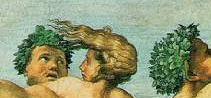
The most famous form of natural material being used as a "crown" is the crown of thorns Jesus wore at his crucifixion. These crowns or hats made of leaves could be symbolic of being divine like Jesus and wearing a crown of natural material due to the characters' divinity.
Michelangelo:
Hand of God Giving Life To Adam:
 |
| Hand of God Giving Life to Adam by Michelangelo (1508 - 1512) Sistine Chapel, Vatican |
The Touch:

Unlike the images I have considered above, this particular hand gesture has not been overlooked or forgotten, due to its focal point in the image and the connotations it carries: with a single touch the God figure is giving life to the Adam figure, an obvious depiction of God's power. This hand gesture is very suggestive of something divine or impossible.
Adams Calm:

Adam's facial expression is a different 'calm' to that of the other divine depictions: in contrast to the others who are looking into the distance or directly at the viewer, this character is fully focussed on the interaction between his hand and God's, nevertheless Adam has an air of calm and serenity rather than elation or joy, which one may consider feeling having been given life. Does this depict a devine calm feeling?
The Woman:

The character of most interest for me in this image is the woman, around which Gods free arm resides protectively or possessively. Reactively this mysterious woman holds his arm with what seems like a loving or affectionate gesture. Could this be suggested to be Eve who has not yet been sent into the garden of eden, though this is unlikely as Eve was created from Adam's own rib? Or could this be a suggestion of God's lover or wife?
A Multitude of Watching Faces:


Not only is Adam's Gaze fully taken by his and God's hand movement, but all other beings, most of which are cherub like, are fully focussed on what is happening. This focus surrounding the hand gestures seems to visually strengthen the connotation of the interaction and somehow make it seem that bit more important.
The Celebration of the Male Body:

In contrast to The Birth of Venus image Adam's genitalia is depicted obviously without need for being covered or for any modesty. Is this a suggestion of what is deemed acceptable in art, male genitals are often celebrated whereas vaginas are often covered, which I intend to look into in more detail throughout my project. This could also be a suggestion of the difference between human and God/ Goddess - Venus in The Birth of Venus and God in this image are fully covered, whereas Adam is human and therefore lesser, meaning he might not be worthy of clothing.
Now that I have looked at and considered a number of existing ways of depicting the divine or inexplainable, I need to consider how I can not only give my take on this idea by utilising these types of depiction, but consider what I can do differently to depict these suggestions.


